
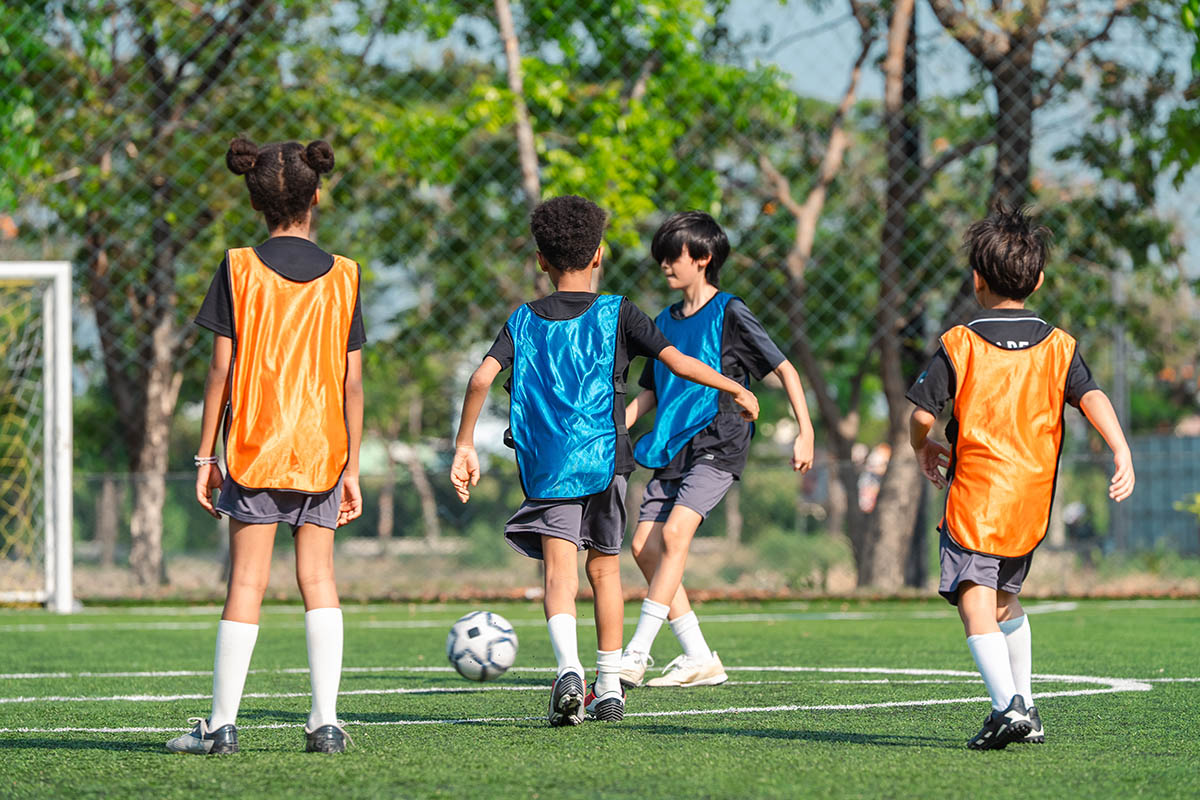
Artificial turf sports fields on campus are leaching chemicals into the environment that can be lethal to salmon and harmful to other aquatic life, UBC researchers say.
The source of the chemical is crumb rubber – a material derived from used tires that is used as an infill on the fields to help create a playing surface meant to resemble natural grass. It is used on a number of fields on campus, including UNA Community Field in Wesbrook Place.
Researchers found crumb rubber leaches a chemical called 6PPD-quinone into the environment when rainwater washes off the fields and is not treated or filtered before entering waterways and stormwater management systems.
Rachel Scholes, an assistant professor of environmental engineering with UBC’s Department of Civil Engineering, said some stormwater from fields on campus goes into salmon-bearing waters in Musqueam First Nation and Cutthroat Creek – a waterway running through Pacific Spirit Regional Park.
Scholes said research began in 2023 after her lab was notified by streamkeepers in North Vancouver who said crumb rubber was washing off a nearby turf field and dead Coho Salmon had been found in a nearby waterway.
Crumb rubber has long been used in roadways, where it is mixed with asphalt to create a more durable driving surface while also diverting used tires from landfills. But its use has come at a cost to aquatic life.
Scholes said it was already known that crumb rubber can leach chemicals into the environment and kill salmon. The professor and her researchers began an investigation by analyzing infill samples from 12 artificial turf fields and collecting water from the fields after rainstorms.
The researchers found that the fields release 6PPD-quinone and other chemicals into the environment every time it rains. Additionally, they found that the fields continue to leach lethal amounts of chemicals for many years after they’re built.
“6PPD-quinone is of particular concern because it is one of the most toxic compounds we know of to aquatic life, and it’s particularly for coho and coastal cutthroat (trout) that it’s most toxic,” said Scholes.
Katie Moloney, a PhD student in Scholes’ lab, said an average turf field contains about 125 tonnes of crumb rubber, which is equal to roughly 20,000 tires.
“With fields typically lasting a decade or more, they can become long-term sources of tire-derived pollution entering stormwater pipes, and ultimately fish-bearing waterways—frequently without treatment,” she said.
Scholes did not say which fields were included in the study, but confirmed a number were located on campus. “I can say that some of the fields at UBC were sampled, and we did see contaminants coming off of those fields,” she said.
UBC’s Point Grey campus has a number of drainage areas. Some stormwater is released into Wreck Beach in north campus. Stormwater also flows south through Wesbrook Place and over Marine Drive before emptying into the northern arm of the Fraser River.
“Some of that stormwater actually does go into salmon bearing waters in Musqueam and Cutthroat Creek, and so that’s where I’d be most concerned about potential impacts in the case of UBC campus,” she said.
To prevent the migration of crumb rubber from the fields, UBC and the UNA have installed catch basin sacks, sump drains, and drainage baskets that catch it before it can spread to surrounding areas.
Kavie Toor, Managing Director at UBC’s Department of Athletics and Recreation said these measures can reduce 6PPD-quinone concentrations by up to 90 per cent.
A bigger concern for Scholes and her researchers is where the runoff water goes.
“The challenge is really that when these fields are designed, they’re designed with these particular pipes, and retrofitting subsurface drainage tends to be quite difficult and expensive,” she said.
When UNA Community Field was due for replacement in 2023, directors discussed the use of alternatives to crumb rubber after then Director Murray McCutcheon raised concerns over the use of microplastics, however no discussion of 6PPD-quinone and its toxicity took place. Despite reservations, a like-for-like replacement of the field using crumb rubber was approved by directors and the field was resurfaced in 2024 at a cost of $1 million.
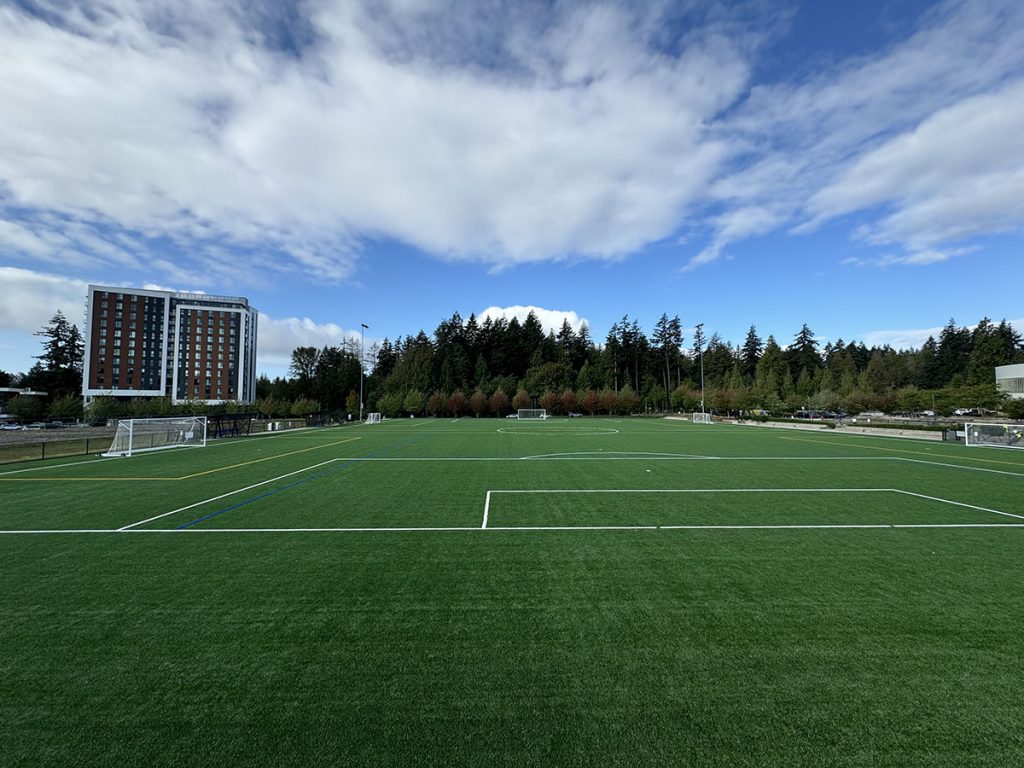
UNA Operations Manager Wegland Sit said he is aware of UBC’s research; however, financial considerations and an existing agreement with the Vancouver School Board – which co-manages the field – creates challenges to address the problem and implement solutions.
Amer AbiRafeh, Wesbrook resident, landscape architect, and member of the UNA’s Land Use Advisory Committee, said research is being carried out on potential solutions to prevent stormwater from carrying chemicals into waterways.
“Current understanding suggests that while sump drains may help collect crumb rubber particles, they do not necessarily prevent 6PPD-quinone from entering runoff,” he said.
He said his employer, civil engineering consultancy R.F. Binnie & Associates, is working with UBC researchers on potential solutions to capture 6PPD-quinone before it enters waterways.
One solution being investigated involves directing water through a biofiltration process, where it would pass through organic media and vegetation before being released into stormwater management systems.
“Early observations suggest this approach may help bind and reduce 6PPD-quinone; however, the effectiveness of this technique is still being studied, and no conclusive results are available at this time,” he said.
Meanwhile, Scholes said another way forward could be to use alternatives to crumb rubber. Infills derived from natural sources such as cork or materials such as EPDM (Ethylene Propylene Diene Monomer) have proven to be less detrimental to aquatic life than crumb rubber.
EMMANUEL SAMOGLOU IS THE MANAGING EDITOR OF THE CAMPUS RESIDENT.