
It isn’t uncommon for residents in different parts of Vancouver to pay different rates for utilities.
For example, the Southeast False Creek neighbourhood has its own, separate energy system with different rates compared to residents in surrounding areas.
In Wesbrook Place – the most populous neighbourhood on campus – there is a significant difference in the rates charged in buildings located within the same vicinity and only metres apart.
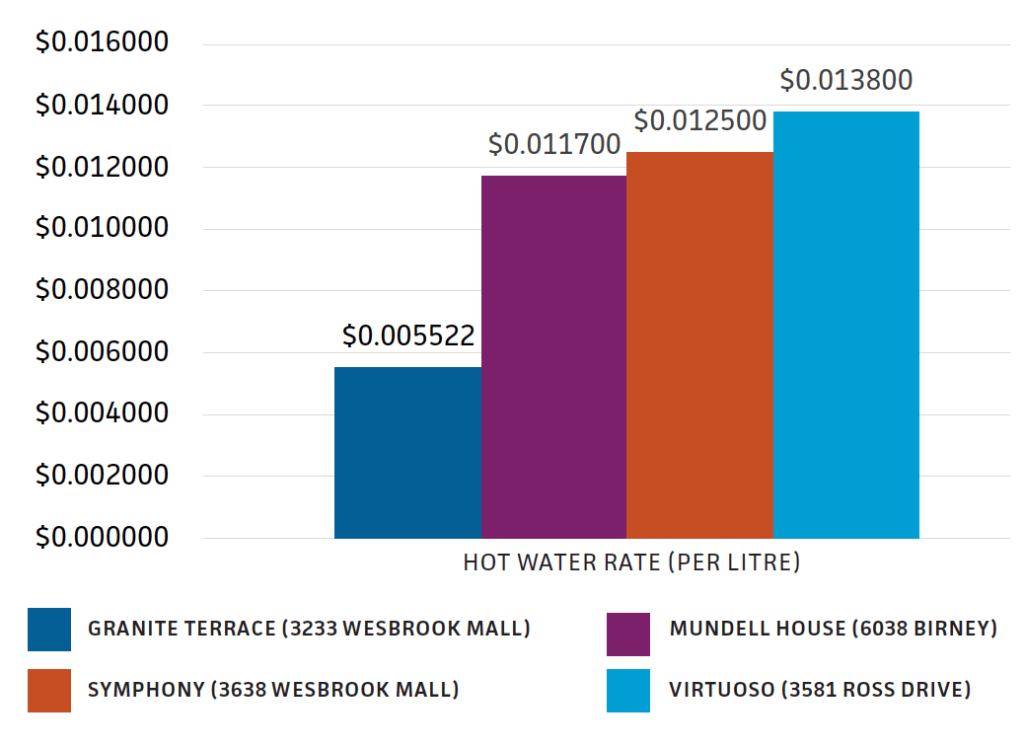
Granite Terrace, Mundell House, Symphony, and Virtuoso are all serviced by utilities submetering company Enerpro, yet are charged different rates for hot water.
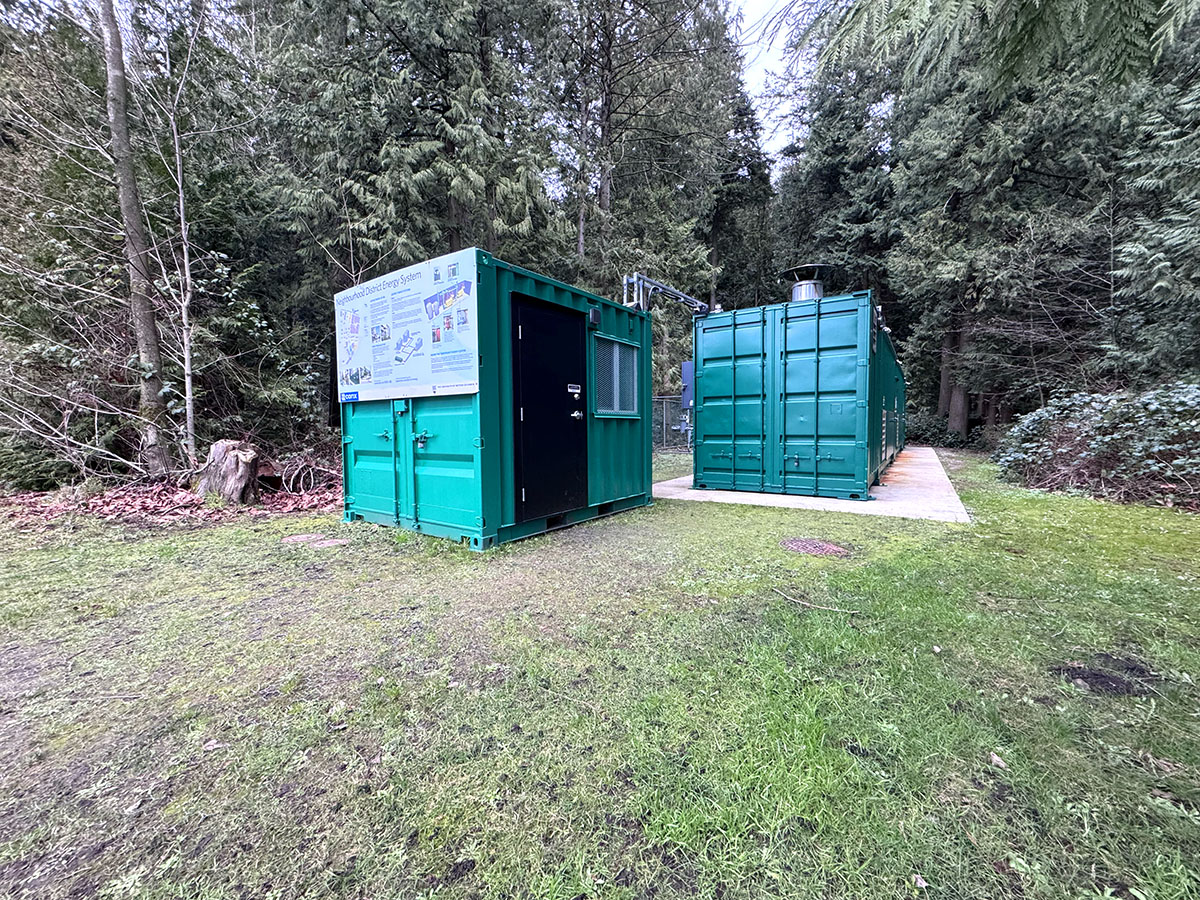
Based on the chart below, Virtuoso residents pay almost three times as much for their hot water as someone living in Granite Terrace. The dramatic disparity between Granite Terrace and the other residences is due to the other buildings being attached to the Neighbourhood District Energy System (NDES) operated by energy utility company Corix. As previously reported by The Campus Resident, 15 buildings connected to the NDES will see a 50 percent increase in heating and hot water rates in the next three years.
According to UBC, buildings connected to the NDES are supposed to “need less equipment and building owners have lower operations and maintenance costs.” Yet, Corix has applied to and received interim approval from the BC Utilities Commission for rate hikes because the project has not met Corix’s revenue predictions.
The result is that ratepayers in Wesbrook connected to the Corix system now pay on average more than twice as much as residents who only pay BC Hydro for their power.
Although this accounts for some of the discrepancy between buildings which are connected to the NDES and those that are not, there still remains the question of why the rates differ for those that are connected.
When asked to explain the disparity, a spokesperson with Enerpro said their rates included fixed and variable components. “… rates can differ between Corix buildings because Corix rates for thermal energy include a fixed cost component charged on a per square meter basis and a variable cost component charged on a per kwh basis. The recovery rate is a blended calculated cost recovery rate of the fixed costs, the variable costs, and the consumption for the building.”
Recovery rates charged by utility companies typically are used to recoup operating expenses and infrastructure investments, however they can often include a variety of expenses that utilities and companies pass on to their customers.
While providing some insight, the explanation leaves unanswered the question of how the various components are determined in the first place, and how they are combined in order to arrive at the overall rates.
For instance, in communications to The Campus Resident, Enerpro claimed that Symphony residents are charged $0.0125 per litre for hot water, with this rate combining a charge of $0.0087/L for heating the water, and sewer access rates of $0.0038/L. However, if all residents of Symphony are paying $0.0125/L this would mean that the square footage component charged to Village Gate Homes by Corix is being “blended” evenly into every resident’s bill regardless of the size of their unit.
In short, a resident living in a three-bedroom apartment bears the same burden as someone in a studio.
Relatedly, it is unclear whether the “blending” of fixed cost components into the residential charges means that tenants pay higher utilities fees simply for living in physically larger buildings.
In Enerpro’s response, the company did state that rates depend partly on the “consumption for the building.” When asked how recovery rates are determined for particular buildings, and what components are blended to arrive at the final recovery rate, Enerpro declined to respond.
Enerpro has claimed that it does not question the rates charged for utilities in the buildings that it services and it simply applies the rates requested by landlords, which in Wesbrook includes Strata and buildings managed by Village Gate Homes (VGH).
In its submissions to B.C.’s utilities regulator, Enerpro goes as far as to claim that it is not the company’s responsibility to ensure that the charges are consistent with relevant laws.
Instead, they claim that is the responsibility of the landlords.
From that perspective, utility rates in Wesbrook are ultimately set by property management entities like VGH, and they charge different rates in each of the buildings they manage.
Strata corporations, like Virtuoso, are independent from VGH, and set their own rates for hot water, which Enerpro then uses to charge residents. Typically, those rates are related to unit size and set using estimates for the amount of natural gas or hydro needed to heat the water. An estimated annual cost would be included in the strata corporation’s annual budget.

The cost recovery rate charged in strata buildings in Wesbrook typically includes the cost of leasing the building’s submetering equipment. In order for Enerpro to circumvent regulatory oversight by not owning any utilities equipment, their meters are leased through a third-party equipment leasing company who technically owns the meters.
It is unclear whether the cost of leasing meters is included in the rates charged in rental apartment buildings in Wesbrook. Tenancy law in BC prohibits landlords from passing the cost associated with maintaining submetering equipment onto tenants through their electric bills.
When asked how the costs are “blended” to determine the cost recovery rate in specific buildings, Enerpro declined to answer.
Without additional information on how the overall rate is determined for each building, it is impossible to know exactly what costs are being passed on to tenants. Village Gate Homes also declined to answer the question of how recovery rates are determined for its buildings.
When asked whether its business practices are compliant with the Residential Tenancy Act (RTA), Enerpro declined to answer directly.
In response to the same question, a spokesperson for Village Gate Homes said it was waiting for the outcome of the BCUC investigation into Enerpro to know whether its existing policies violate residential tenancy law.
It is unclear why VGH is waiting for the BCUC to reach a decision given that the RTA is administered by the provincial Residential Tenancy Branch and not the utilities regulator.
ERIC WILKINSON IS A POSTDOCTORAL FELLOW IN THE DEPARTMENT OF PHILOSOPHY AT UBC. HIS REPORTING HAS APPEARED IN BRIARPATCH, CANADIAN DIMENSION, AND PEACE MAGAZINE, AMONG OTHER OUTLETS.