
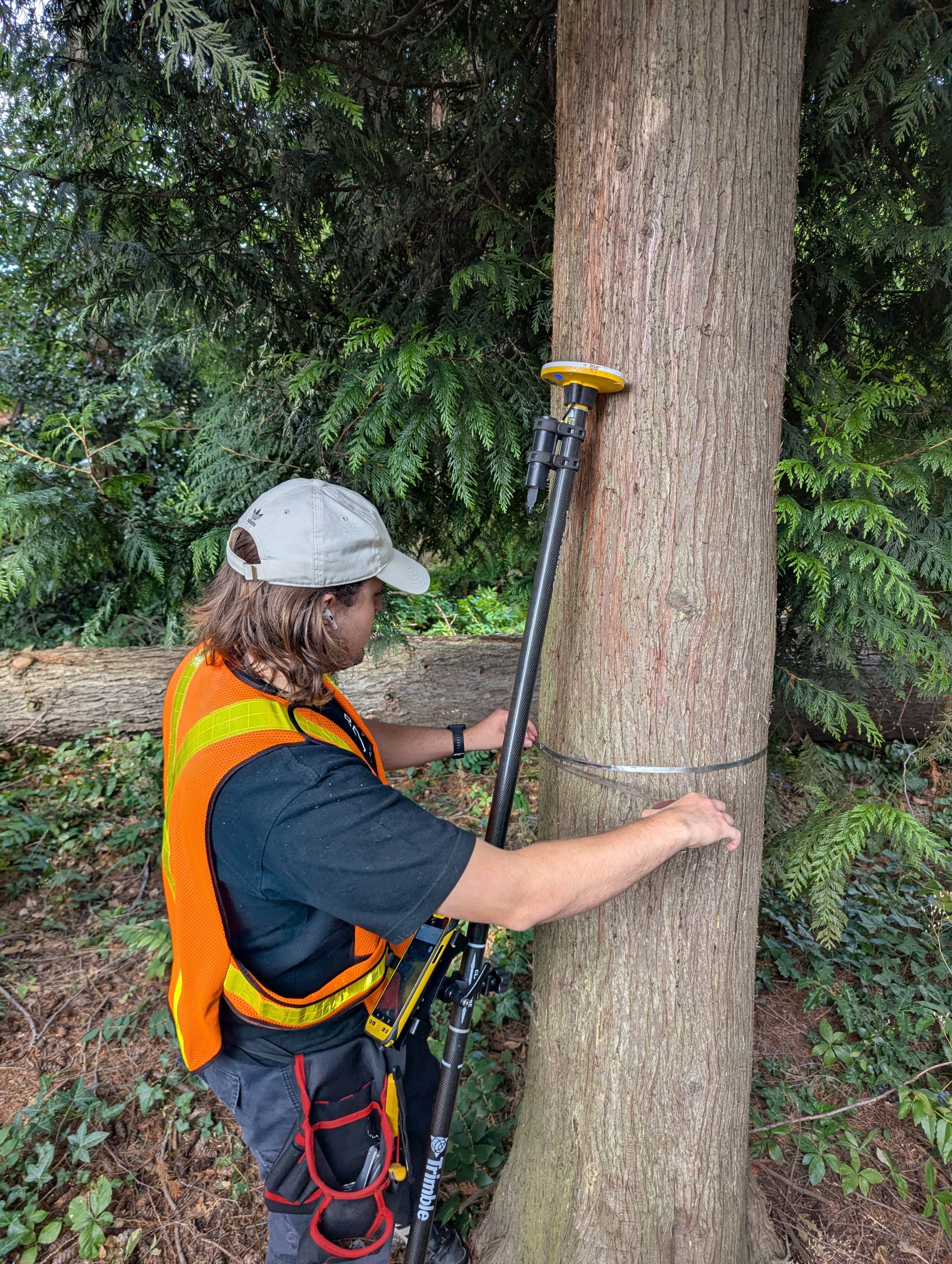
A UNA and UBC partnership has produced a comprehensive inventory of every tree in the university neighbourhoods. The inventory will help lead to a more proactive approach to the management of the local urban forest.
In June 2025, UBC’s Urban Ecology & Sustainability Lab (UESL) began field research to create an inventory of trees in the university neighbourhoods. The project’s goal was to create a dataset containing every tree with basic information about them like species, size, location, and condition.
“In urban forestry, a tree inventory is almost like the bite-size information for guiding management, streamlining operations, and building analyses from,” says Aubrey Benson, a research associate and lab manager at the UESL. “Once trees are mapped and measured one by one, that information can be used to understand broader patterns across streets, neighbourhoods, and the wider peninsula.”
This project was carried out in partnership between the UESL, a lab within UBC’s Faculty of Forestry, and the UNA. The UNA funded the research, and the purpose of the inventory is to support the UNA’s planning and management of landscapes.
“The tree inventory report is part of a comprehensive, three-pronged initiative designed to transition our urban forestry management from a reactive model to a proactive, data-driven system,” says Wegland Sit, the UNA’s operations manager.
This system includes the development of tree management guidelines and collaborative research opportunities, in addition to the tree inventory study.
The project plays a role in the UNA’s broader Landscape Management Plan. The tree inventory will allow the UNA to address immediate issues, but also to track changes over a long period of time.
“The dataset provides the UNA with the exact tree counts, species distribution, and health conditions necessary to make informed operational and financial decisions,” says Sit.
It will also provide risk mitigation, research opportunities, and an interactive dashboard for the public to learn about the trees in their neighbourhood, Sit adds.
The initial inventory was completed in October 2025. Areas surveyed include the neighbourhoods Chancellor Place, Hawthorne Place, East Campus, Hampton Place, and Wesbrook Place. Three natural areas, Rhododendron Woods, East Campus Park, and Chancellor Forest Patch, were surveyed as well.
“Some areas were definitely more challenging than others,” says Benson. “Street and park trees are generally more straightforward because they were planted and deliberately spaced, making them easier to access. The natural areas are more difficult because plants are typically more densely packed and more complex, with spontaneously growing vegetation.”
In all, researchers found 4,087 total trees, with 96 unique species and 54 genera. A total of 2,973 of the trees were street and park trees, and 1,114 were natural area trees.
The tallest trees measured were two Douglas firs, both recorded at 55.5 metres. Western red cedar was the most common species overall, while the street tree population had a lot of maples. The natural areas included more trees native to the region, while the street trees were more decorative.
tree. (Photo: Evan Shea)
“My personal favourite finding so far is that our students noticed a group of tulip trees planted along the same street that were in strikingly different condition, despite what appeared to be relatively similar growing environments,” says Benson. “To me, that shows the importance of understanding how individual trees respond to micro-scale conditions, which is increasingly urgent as urban trees face growing pressure from climate change and development.”
Maintaining the inventory is an ongoing commitment for the UNA. They plan to do a full inventory assessment every 3-5 years to track tree health and canopy cover over the long term, continue working with the UBC urban forestry researchers on UNA-focused projects, and eventually integrate the dataset with an upcoming UBC tree inventory platform.
In the meantime, the inventory will be available to the public soon.
“In collaboration with the UBC Urban Forestry Research Group, we have developed a public, front-facing tree inventory dashboard,” says Sit. “We are currently working alongside our communications department to finalize the launch details and expect to release this dashboard on the UNA website in the near future.”
While this current dataset focused only on the university neighbourhoods, the UNA and UBC are collaborating on producing a regional tree inventory. “The UBC group is actively at the planning stages of a unified platform that would serve both UBC and the UNA,” says Sit.
“We are incredibly excited about this project, and the potential operational efficiencies and environmental benefits that a truly regional approach will bring to the entire peninsula.”
AMIE BERNAERDT IS A FIFTH YEAR STUDENT AT UBC, MAJORING IN CREATIVE WRITING AND ANTHROPOLOGY. SHE LIVES IN WESBROOK PLACE.